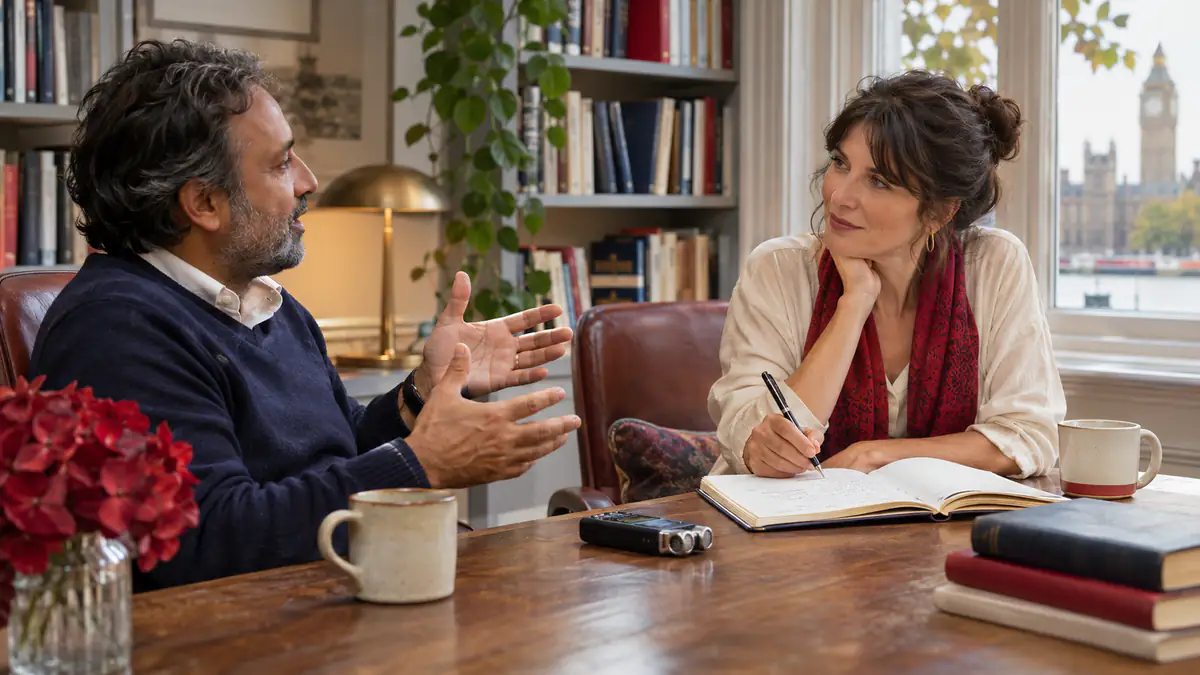
Developmental, Line and Copy Editing Explained
Authors often ask for 'an edit' without realising it covers at least three distinct jobs. Here's what each one actually does.
 Book Editing
"I need my manuscript edited" is one of the most common things a first-time author says, and one of the least specific. Editing isn't one task — it's at least three distinct stages, each addressing a different layer of the manuscript, and each needing to happen in a particular order. Commissioning the wrong one, or doing them out of sequence, is a common source of wasted money and frustration.
Developmental editing: the big picture
Developmental editing addresses structure, plot, pacing, characterisation and — for non-fiction — the strength and organisation of the argument. A developmental editor is asking: does this book work as a whole? Is the structure sound? Does the middle sag? Does the protagonist's arc make sense? Does the argument build logically?
Developmental feedback usually comes as an editorial letter and in-manuscript comments, not line-by-line rewriting, and it typically leads to substantial revision — restructuring chapters, cutting subplots, rewriting the ending — before the manuscript is ready for the next stage. It's the most significant stage in terms of how much the manuscript might change, and it should always happen first.
Line editing: the sentence level
Line editing works at the level of paragraphs and sentences, addressing prose style, voice, clarity, pacing within scenes, and word choice. A line editor isn't rewriting your plot; they're asking whether each sentence does its job — whether it's clear, whether it's doing something the surrounding sentences aren't already doing, whether the voice is consistent.
This stage only makes sense once the structure is settled through developmental editing — there's little point perfecting the prose of a scene that might be cut or substantially rewritten.
Copy editing: grammar, consistency and correctness
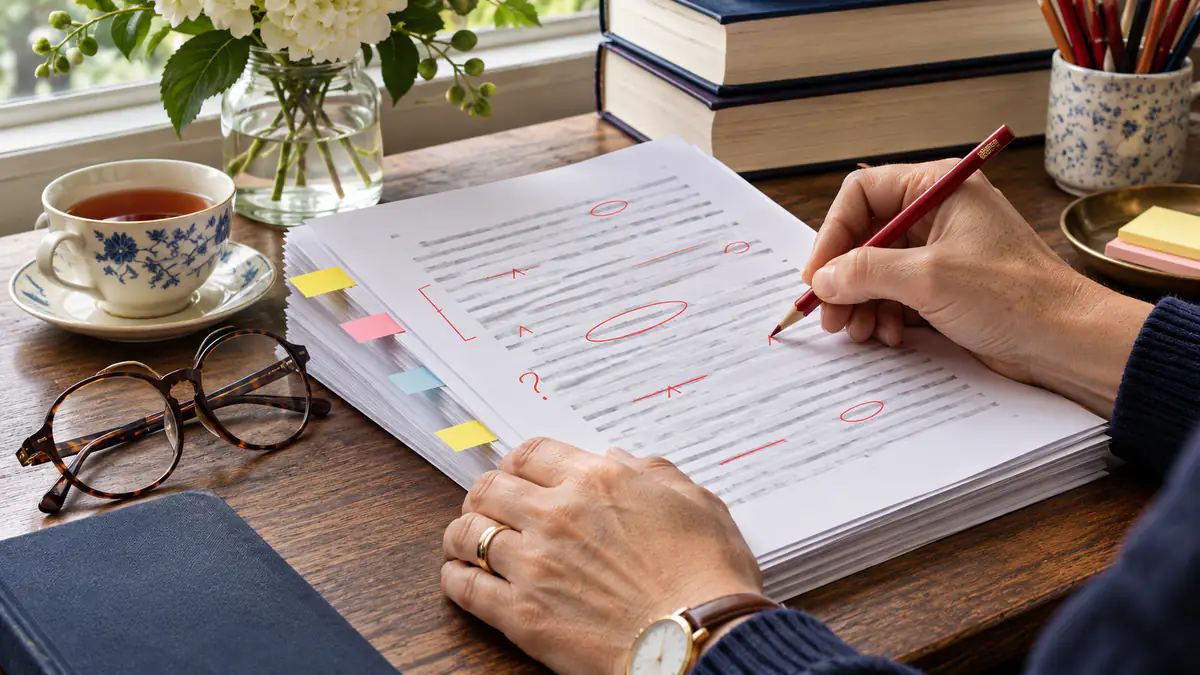
Copy editing focuses on grammar, punctuation, spelling, consistency (character names, timeline details, spelling of invented terms) and house style — for UK publication, that usually means UK spelling and punctuation conventions. A copy editor isn't assessing whether the story works; they're making sure it's correct and internally consistent.
Copy editing happens after line editing, on a version of the manuscript that isn't going to change structurally or stylistically again in any significant way.
How this differs from proofreading
Proofreading is a distinct, final stage — a last check for errors after the manuscript has been formatted or typeset, catching anything that slipped through copy editing or that formatting itself introduced (a dropped word, an inconsistent heading style, an awkward page break). It is not the place to be rewriting sentences or restructuring content; by this stage, that work should already be done.
A simple way to tell the stages apart
| Stage | Focus | Typical output |
|---|---|---|
| Developmental | Structure, plot, argument | Editorial letter, major revisions |
| Line | Prose style, voice, clarity | In-text edits, sentence-level rewrites |
| Copy | Grammar, consistency, house style | Tracked changes, style sheet |
| Proofreading | Final error check post-formatting | Marked corrections, no rewriting |
What this means if you're commissioning an edit
When approaching a freelance editor, it's worth being specific about which stage you need, and honest with yourself about where the manuscript actually is. A manuscript with real structural issues won't be fixed by a copy edit, however thorough — the problems a copy edit catches are a different layer entirely from the ones a developmental edit addresses. Many editors offer a sample edit of a few pages before you commit to a full manuscript; this is a reasonable way to check both their approach and that you've asked for the right stage of editing in the first place.
If you're editing your own work
Self-editing is possible, but it benefits enormously from distance and from deliberately separating the stages rather than trying to fix everything in one pass. Reading the whole manuscript once purely for structure, without touching a single sentence, then doing a separate pass for prose, and only then a final pass for grammar and consistency, tends to catch far more than trying to do all three simultaneously — largely because each pass asks a different question of the text.
Editorial Team
London Writers Editorial Team
Our editorial team researches UK publishing practices, writing craft and the self-publishing landscape to produce practical, plain-English guidance for authors. Articles are reviewed against our editorial policy before publication and updated when the underlying guidance changes.